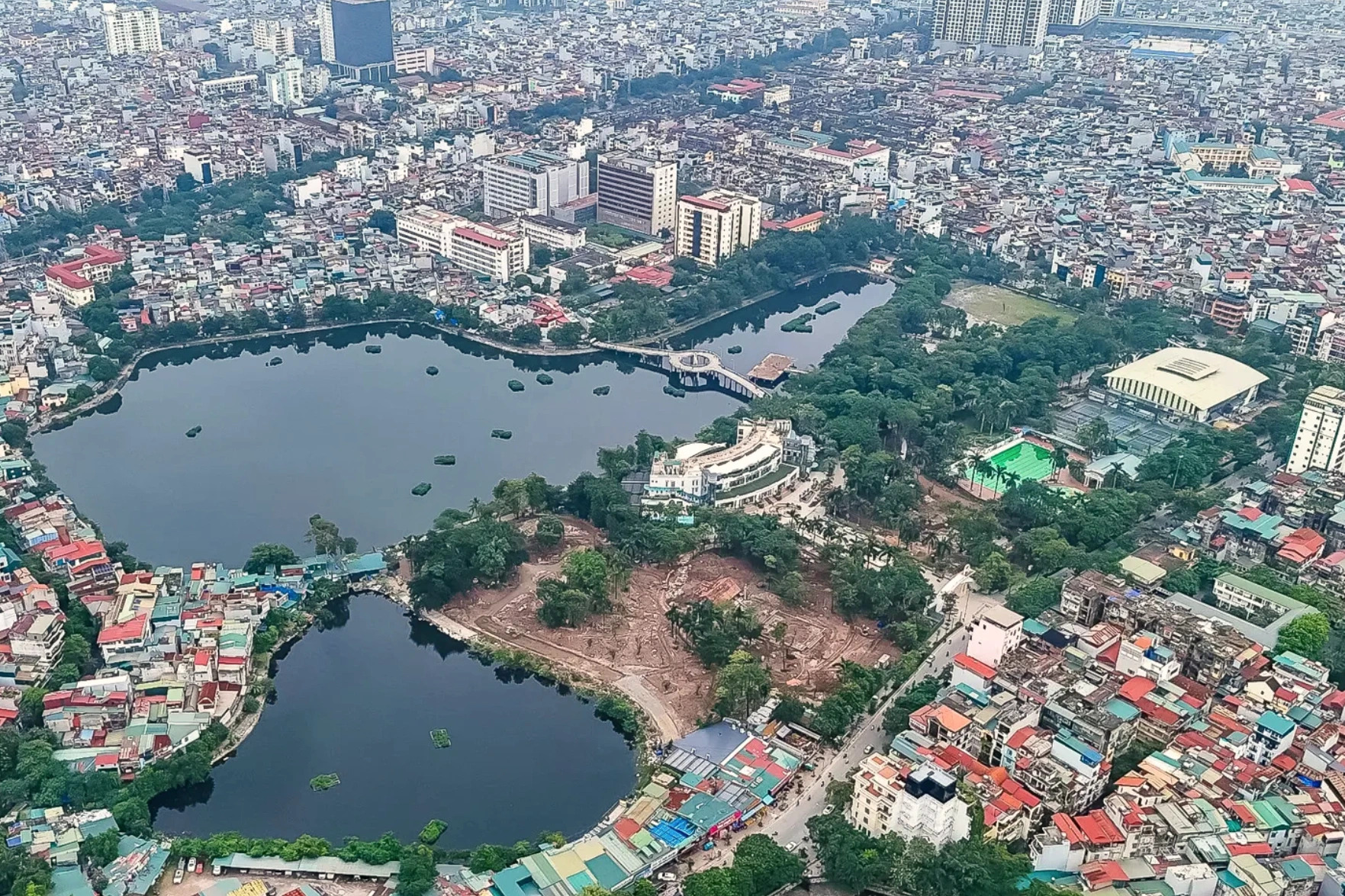
 An aerial view of Vo Thi Sau Street, near Vo Thi Sau Park. Photo: Economy & Urban
In its action plan to implement Resolution 80-NQ/TW, Hanoi aims to build a diverse cultural and creative ecosystem by 2030, based on preserving and promoting the values of Thang Long – Hanoi. The new City Theater on Vo Thi Sau Street, Hai Ba Trung Ward, has been identified as one of the key projects, playing a crucial role in the infrastructure for contemporary performing arts.
With an area of approximately 9,000 m² and a seating capacity of 2,000-2,500, this building is expected to become a space for organizing high-quality art programs, bringing classical music and top-tier performance art closer to the public.
Beyond its function as a performance venue, the new theater is also expected to become a cultural highlight, contributing to attracting tourists and shaping Hanoi’s image as a destination for art and creativity. The trend of developing tourism linked to cultural experiences, especially high-quality performances, is becoming increasingly evident in major cities around the world, and Hanoi is gradually adopting this model.
Alongside the theater project, Hanoi is also implementing a series of large-scale cultural projects and spaces, such as the restoration of the Kính Thiên Palace within the Thăng Long Imperial Citadel World Heritage Site, the expansion of the Văn Miếu – Quốc Tử Giám complex, the construction of a 20,000-seat cultural center along the Red River axis, and other new iconic landmarks of the capital city.
Notably, the city aims to develop 3-5 integrated cultural and tourism zones at heritage-rich locations such as Co Loa Citadel, Giong Temple, Huong Son complex, and the West Lake area. These zones will not only serve as heritage preservation areas but also as places to develop experiential tourism products, combining culture, spirituality, and creativity.
In the long term, Hanoi aims to become a cultural and creative hub with regional influence by 2035, and a major cultural and arts center of Asia by 2045. The cultural industry is envisioned as a key economic sector, contributing approximately 12% to the city’s GRDP, while simultaneously improving the quality of life and cultural experiences for its citizens.
Therefore, the 2 trillion VND investment in the theater is not just about building a new structure, but a step in a long-term strategy to connect culture with tourism, create momentum for sustainable development, and elevate Hanoi’s position on the regional cultural map.
Several key theaters and performance venues in Hanoi have recently been inaugurated, or are under construction or renovation:
• Ho Guom Theatre
Completed and put into operation in 2023, this modern, large-scale facility serves high-quality art programs and contributes to providing new performance spaces in the heart of the capital city.
• Hanoi Opera House
Construction is scheduled to begin in October 2025 and is expected to be completed in 2027-2028. With a capacity of over 2,000 seats and designed by architect Renzo Piano, it is anticipated to become an iconic cultural and tourist landmark of international stature in Hanoi.
• Hanoi Opera House
Completed in 1911, this historic building has undergone numerous restorations and renovations (notably major ones between 1995 and 1997 and subsequent routine maintenance). The Grand Theatre serves as both a performance space and a distinctive architectural and tourist attraction in the capital city, currently undergoing restoration and upgrading as part of a conservation plan .
Source: https://baovanhoa.vn/van-hoa/ha-noi-xay-nha-hat-2000-ti-tao-cu-hich-cho-du-lich-van-hoa-213901.html